
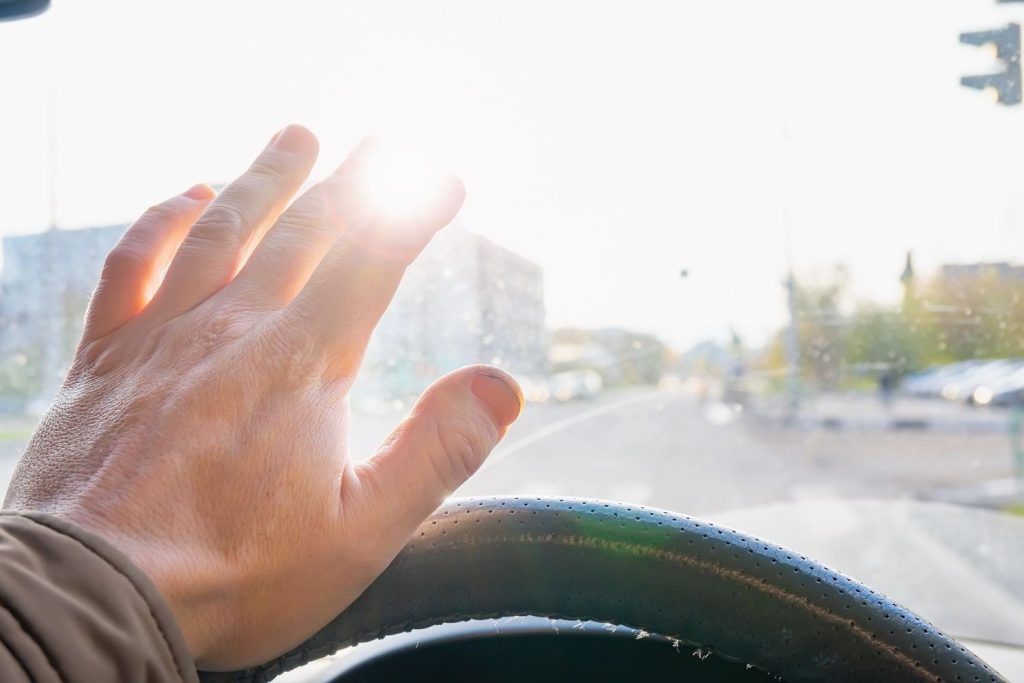
Sun glare is a common driving hazard in Las Vegas, especially during morning and evening commutes when the sun sits low over the valley. Westbound routes can be difficult near sunset, while eastbound travel may bring intense glare after sunrise. Roads such as Interstate 15, U.S. 95, the 215 Beltway, Charleston Boulevard, Sahara Avenue, and Flamingo Road can become challenging as buildings, curves, and overpasses change the angle of sunlight.
Glare can make traffic signals, lane markings, pedestrians, cyclists, motorcycles, and stopped vehicles difficult to see. Dust, fingerprints, scratches, and haze on a windshield can further reduce visibility.
Drivers must use reasonable care when visibility is limited. Bright sunlight does not automatically excuse a collision. Responsibility may depend on speed, following distance, braking, roadway conditions, and whether a driver adjusted to the glare.
Before driving in bright sunlight:
- Clean the windshield and replace worn wiper blades.
- Keep sunglasses accessible and use the sun visor when needed.
- Slow down gradually and increase your following distance.
- Use low-beam headlights to improve vehicle visibility.
- If visibility becomes unsafe, pull into a lawful parking area rather than stopping in traffic.
After a sun-glare accident, call 911 if you need emergency assistance, and move out of traffic when safe and lawful. Exchange contact and insurance information, photograph the scene, and document the time, weather, travel direction, and visibility conditions.
Preserving evidence is important because dashcam recordings may be overwritten, vehicles may be repaired, and roadway conditions can change. Photographs, witness accounts, and available electronic records may help establish what happened.
Nevada follows modified comparative negligence rules, meaning courts may share responsibility when multiple parties contribute to a crash. The outcome depends on the circumstances and the evidence available.
A Sun Glare Accident Lawyer in Las Vegas can review insurance coverage, medical records, lost income, property damage, and applicable deadlines. Heidari Law Group can evaluate the circumstances and explain available legal options.
How Las Vegas Attorneys Reconstruct Sun Position at the Crash Scene
Determining the sun’s position at the time of a collision can help establish whether glare affected a driver’s ability to see the road.
Attorneys may begin by confirming the crash location, date, time, travel direction, and lane position. Police reports, 911 records, photographs, and electronic timestamps can help establish an accurate timeline. Because device clocks may be inaccurate, investigators sometimes need to compare recorded times.
Once investigators confirm the location and time, they can they cancalculate the sun’s position to determine whether sunlight may have entered the driver’s windshield. Tools provided by the National Oceanic and Atmospheric Administration (NOAA) can estimate the sun’s direction and angle above the horizon.
Surrounding structures can also affect visibility. Buildings, mountains, overpasses, trees, and roadway barriers may temporarily block sunlight, then expose drivers to sudden glare.
Investigators may review:
- Photographs and roadway measurements showing the direction of travel.
- Solar-position calculations for the time of the accident.
- Weather records documenting clouds, dust, or haze.
- Nearby structures that may have blocked or reflected sunlight.
- Windshield conditions and available visibility evidence.
These findings can help explain the lighting conditions leading up to a crash. However, the sun’s position alone does not establish responsibility. Driver behavior and other circumstances must also be considered.
Can a Lawyer Challenge a Driver’s Sun Glare Defense?
A driver may claim that bright sunlight prevented them from seeing another vehicle, pedestrian, or traffic signal. However, glare does not automatically excuse a collision.
An attorney may examine whether the driver took reasonable precautions as visibility decreased. This includes determining whether the driver reduced speed, maintained sufficient distance, and responded appropriately to surrounding traffic.
Evidence may reveal whether the driver had an opportunity to recognize the hazard before impact. Video recordings, witness statements, and vehicle information can help evaluate the driver’s actions.
Other relevant questions include:
- Did the driver continue traveling at the same speed despite reduced visibility?
- Was the driver following another vehicle too closely?
- Were sunglasses or a sun visor available?
- Did distraction contribute to the collision?
- Were the driver’s statements consistent with the available evidence?
A driver’s account may also be compared with statements made to police, insurance representatives, or witnesses. Inconsistencies do not necessarily establish fault, but they may require further investigation.
The injured person’s actions may also affect how responsibility is assigned. A lawyer can evaluate everyone’s conduct rather than relying solely on a driver’s explanation of the glare.
Attorney Review of Speed and Visibility in Bright Sunlight
A driver’s speed must be considered alongside how far ahead they could reasonably see. Traveling at the posted speed limit does not necessarily mean the speed was appropriate when sunlight reduces visibility.
Attorneys may examine how much time and distance a driver had to recognize a hazard, react, and stop before impact.
Several factors can affect this assessment:
- Vehicle speed: Higher speeds generally increase the distance needed to stop.
- Reaction time: Limited visibility may delay recognition of traffic signals, vehicles, or pedestrians.
- Roadway conditions: Pavement surface, road grade, and tire condition can influence braking performance.
- Vehicle performance: Weight and braking condition may affect stopping distance.
- Available visibility: Shadows, glare, and surrounding structures can influence when a hazard becomes visible.
Las Vegas roadways present different challenges. Traffic on Interstate 15 may move suddenly from shade into direct sunlight near interchanges. Low sunlight can affect traffic-signal visibility along Charleston Boulevard, Flamingo Road, and Sahara Avenue. Higher speeds on the 215 Beltway may leave less time to respond to unexpected hazards.
Attorneys may compare speed estimates, braking information, roadway measurements, and available reaction time to determine whether a driver adjusted appropriately.
Limited visibility may indicate that slowing earlier was necessary. However, a sudden obstruction could leave a driver with little time to react. Each situation requires an individual review.
The Nevada Department of Motor Vehicles Driver Handbook guides drivers in adjusting their driving behavior to changing road and visibility conditions. When bright sunlight makes traffic signals, vehicles, or pedestrians hard to see, drivers may need to slow down and increase their following distance. These precautions can help drivers respond more safely to unexpected roadway hazards.
Heidari Law Group can examine these factors alongside medical documentation, vehicle information, and insurance coverage when evaluating a sun glare accident claim.
What Can Dashcam Footage Reveal to a Sun Glare Accident Lawyer?
Dashcam footage can provide valuable information about the moments before and during a sun glare collision. Recordings may show traffic conditions, vehicle movements, brake lights, signal changes, and sudden changes in sunlight.
For example, footage may reveal whether a vehicle moved from a shaded roadway into direct sunlight or whether glare developed gradually as the driver approached an intersection.
However, dashcam recordings do not always represent exactly what a driver could see. Cameras automatically adjust brightness, exposure, and contrast, which can make some objects appear clearer or darker than they appeared through the windshield.
Camera placement, windshield tint, reflections, and recording settings may also affect the image.
A recording may contain additional information, including:
- Date and time of the collision.
- GPS location and recorded vehicle speed.
- Audio of braking, horns, or other sounds.
- Traffic movement before impact.
- Footage from rear-facing or interior cameras.
Review this information carefully because recording timestamps, GPS readings, and camera settings may not always be accurate.
Preserve original recordings whenever possible. Editing or exporting footage can remove metadata or reduce image quality, while some dashcam systems automatically overwrite older recordings.
The National Highway Traffic Safety Administration (NHTSA) explains that some vehicles contain event data recorders that capture technical information shortly before, during, and after a collision. Depending on the vehicle, this information may include speed, braking activity, and other driver inputs. Unlike dashcams, these systems do not record ordinary video footage, but their data may provide additional context when investigating a sun glare accident.
A Sun Glare Accident Injury Lawyer in Las Vegas can review the footage alongside physical damage, roadway conditions, and other available evidence. Its usefulness depends on the recording’s authenticity, completeness, and relevance to the collision.
Frequently Asked Questions
Is a driver responsible for an accident caused by sun glare in Las Vegas?
A driver may be responsible if they fail to take reasonable precautions when sunlight limits visibility. Bright sunlight does not automatically excuse a collision. Investigators may consider speed, following distance, braking, and whether the driver adjusted to the conditions.
Can I file an injury claim if another driver says the sun blinded them?
You may be able to pursue a personal injury claim if another driver’s negligence contributed to the collision. A sun glare claim does not automatically remove responsibility. Available evidence, insurance coverage, and the accident circumstances can affect your legal options.
What if both drivers contributed to a sun glare accident?
Nevada follows modified comparative negligence rules, which can divide responsibility between drivers. Generally, an injured person’s recovery may be reduced by their percentage of fault, and recovery may be barred if their fault exceeds 50%. How these rules apply depends on the circumstances and parties involved.
Should I contact a lawyer after a sun glare accident in Las Vegas?
Speaking with a lawyer may help you understand your options, especially if you have injuries, disputed liability, or insurance issues. An attorney can review the evidence, assess potential liability, and explain any deadlines that may apply to your claim.

Free Case Evaluation 24/7
Contact Us
CASE RESULTS
$500,000
Rear-End Accidents
$500,000
Sideswipe Accidents
$1.1 Million
Head-On Accidents
$2.0 Million
T-Bone Accidents
$1.0 Million
Single-Vehicle Accidents
Case Results
$3.3 Million
Motorcycle Accident
$2.0 Million
Car accident
$1.4 Million
Brain Injury
$1.1 Million
Motor Vehicle Accident
Related ArticlesHeidari Law Group
- Accidents Caused by Loose Gravel on Las Vegas Roads
- Las Vegas Car Accidents During Flash-Flood Conditions
- Car Accidents During Las Vegas Dust Storms
- Accidents Involving Disabled Vehicles Stopped on Las Vegas Highways
- Las Vegas Car Accidents Caused by Sudden Highway Traffic Slowdowns
- Accidents Caused by Faded or Incorrect Lane Markings in Las Vegas
- Highway Construction-Zone Car Accidents in Las Vegas
- Las Vegas Car Accidents Caused by Missing or Obstructed Road Signs